Let’s set the scene. You’re in a conversation—maybe with your partner, a friend, a parent—and you bring something up that bothered you. Nothing dramatic. Just a “Hey, when you said that thing earlier, it kinda hurt.”
And suddenly, the room shifts.
They laugh. They roll their eyes. They say, “That never happened,” or, “You’re being dramatic,” or, “Wow, you’re so sensitive lately.”
You start to wonder:
Am I overreacting? Did I remember that wrong? Is it me?
If that sounds familiar, welcome to the world of gaslighting—a manipulation tactic so sneaky, you often don’t see it until your reality feels like it’s been rewritten.
🎭 So, What Is Gaslighting?
Gaslighting is a form of emotional abuse where someone intentionally makes you doubt your own thoughts, feelings, memories, or sanity.
The term comes from the 1944 movie Gaslight, where a man slowly manipulates his wife into thinking she’s going insane by dimming the gaslights in their home and then denying it’s happening. (Creepy, right?)
But here’s the modern version:
Gaslighting sounds like:
- “You’re imagining things.”
- “That’s not what I said.”
- “You’re crazy.”
- “You always make things about you.”
It’s not just a one-time lie. It’s a pattern. A system. A way to shift power by destabilizing someone’s sense of truth.
🧠 Why It Works (And Why It Hurts)
The scary thing about gaslighting is that it doesn’t usually start with yelling or insults. It starts with doubt.
And self-doubt is a master key. Once someone has you questioning your own instincts, they can rewrite the whole story.
You might start:
- Apologizing for things you didn’t do.
- Second-guessing your emotions.
- Relying on the abuser to “make sense” of what happened.
In short: you lose trust in yourself.
But the truth is:
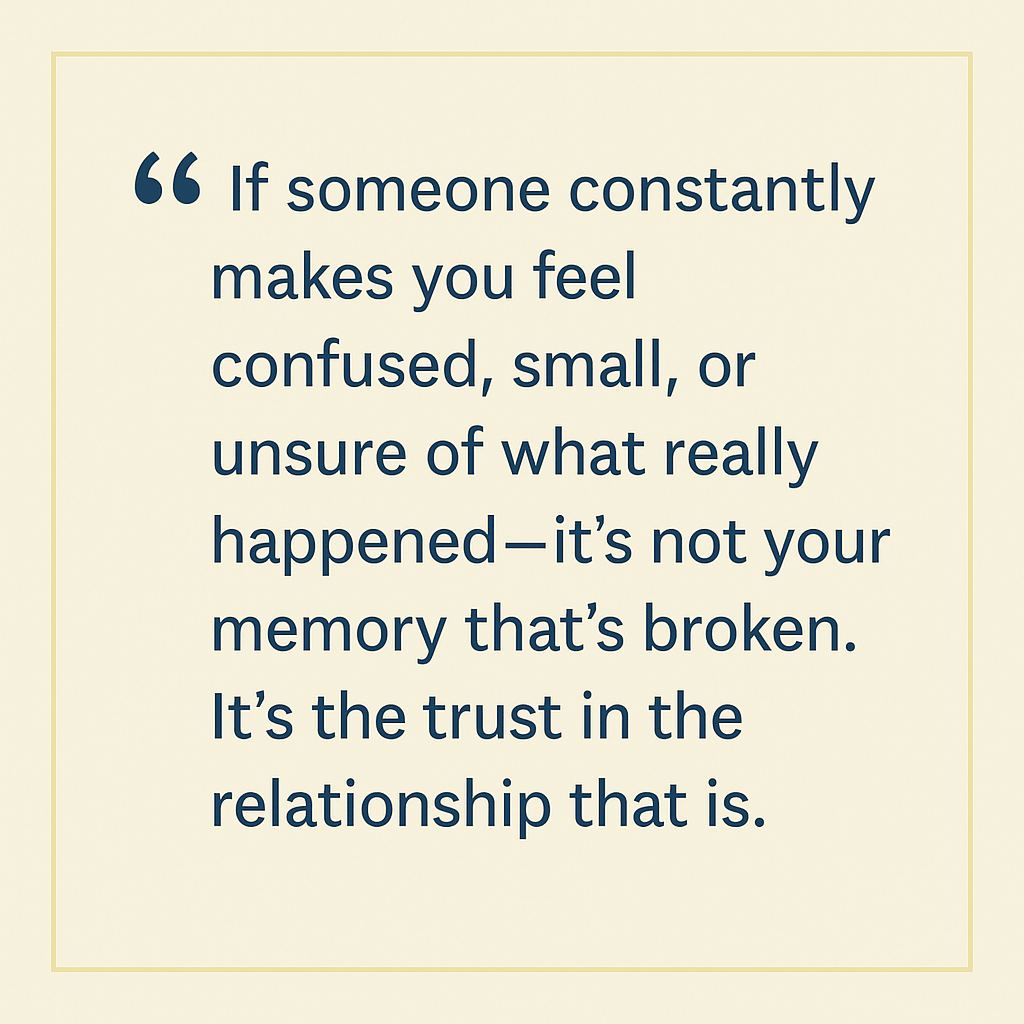
If someone constantly makes you feel confused, small, or unsure of what really happened—it’s not your memory that’s broken. It’s the trust in the relationship that is.
💡 You’re Not “Too Sensitive”
One of the most common gaslighting phrases survivors hear is:
“You’re just too sensitive.”
But guess what? Empathy and sensitivity are strengths. They’re not weaknesses—they’re exactly what abusers try to exploit because they know you’ll question yourself before you ever question them.
And let’s be clear: there’s nothing “too sensitive” about asking for honesty, respect, or basic decency.
🧭 Reclaiming Your Inner Compass
If you’ve been gaslit, it can take time to find your way back to solid ground—but you can.
This week, we’re going to walk that path together. We’ll name the tactics, untangle the confusion, and most importantly, help you rebuild your relationship with the one person you can always trust: yourself.
Because no one gets to rewrite your story but you.
🔁 Reflect & Share
Have you ever been made to feel like you were “too emotional” or “misremembering” something important?
Share your thoughts in the comments or journal privately today—you’re not alone, and your experience matters.
~Marcia McAvoy 2025
 A Day in the Life of Me
Leave a comment